Top of page.
- Skip the menu to main contents.
Link for header starts here.

ここから本文です。
Regular Press Conference (September 18, 2013)
JAL held a regular press conference on September 18, 2013.
The President's greeting is posted as follows:
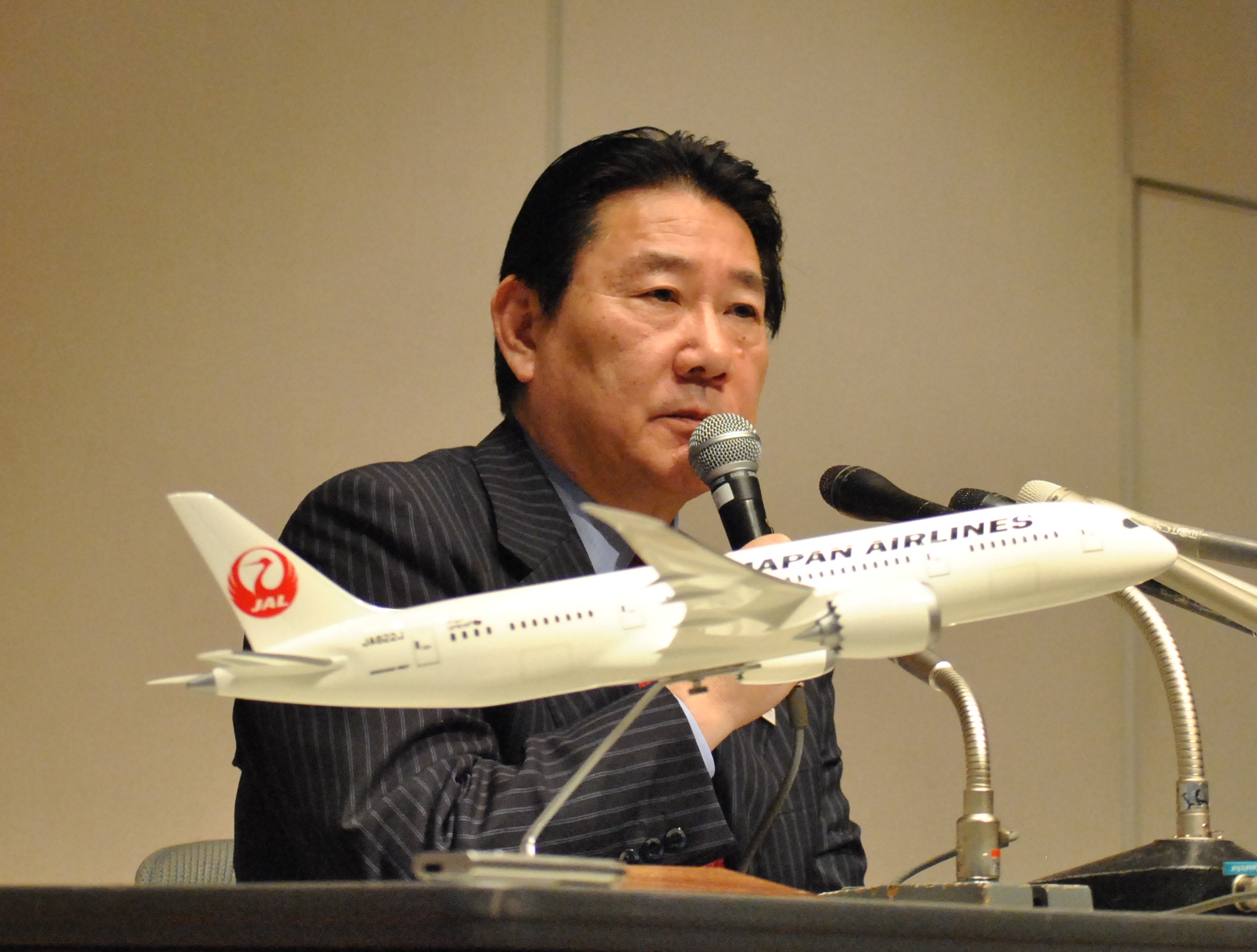 Yoshiharu Ueki
President
Thank you for coming today.
Tomorrow, September 19, will be exactly one year since Japan Airlines relisted on the First Section of the Tokyo Stock Exchange.
Before I deliver my report, I would express my sincere apologies for the substantial inconveniences to our customers, our former shareholders, and many people who were affected by JAL's commencement of corporate reorganization proceedings on January 19, 2010.
JAL received the capital injection of 350 billion yen from the Enterprise Turnaround Initiative of Japan (ETIC) after its bankruptcy, and was able to relist on September 19, 2012 before the termination of support from ETIC. We relisted with a market capitalization of 687.3 billion yen, the offering price being 3790 yen, and as a result, we were able to repay ETIC without any loss in the capital injection. This was made possible through the understanding and support of the customers who continued to use JAL, our business partners, and many other parties, and we express our sincere gratitude to everyone.
Today, I have four points to report on, and they are:
1. Reviewing the past year since JAL's relisting;
2. The direction of our growth strategies;
3. Contributing to the betterment of society; and
4. Our domestic routes and network.
Firstly, I would like to review the past year since JAL's relisting.
Flight Safety
Our customers have been affected by inconveniences and concerns due to battery problems aboard the Boeing 787, but we resumed its operations after completing comprehensive measures to eliminate all possible causes, and are handling all irregularities, as well as battery irregularities, in great detail. We remain committed to ensuring safe operations of all our aircraft, including the Boeing 787.
Routes, Products and Services
We introduced new products and services to provide customers with unparalleled service. For example, we launched new services from Tokyo (Narita) to Boston, San Diego and Helsinki, deployed aircraft with new seats in every class, starting with the London route in January 2013, and improved flight schedules on domestic routes. In addition, JAL was recognized as the world's number one for on-time arrivals through continuous approaches to improve on-time performance.
A general meeting of shareholders was held in June 2013 for the first time since our relisting. We strongly felt the shareholders' high expectations of JAL. Although I am not in a position to say this, JAL's share prices have increased from the offering price, and I feel a sense of responsibility. Though uncertainties lie ahead in the operating environment, such as risk events, the global economy, and trends in exchange rates, I said last year at the time of our relisting that we would become a company which kept its promises, and pledged to achieve our goals no matter what.
Marking one year since the relisting, I would like to express our commitment to maintain flight safety, and our aspirations to establish a firm financial foundation which is resilient to external changes, rank No. 1 in customer satisfaction, and increase our corporate value.
Now I would like to move on to the second point, the direction of our growth strategies.
We will put more weight on increasing our corporate value, and at the same time, contribute to the betterment of society. We will not aimlessly expand our business fields, but instead focus on the air transport business, and bridge Japan and the world, and the world and people and goods of every nation. By gaining strength for future growth, we will contribute to the betterment of society.
The additional departure and arrival slots for international flights at Haneda airport will trigger a major change in the operating environment. I think it will be a good opportunity for more overseas travelers to visit Japan and know more about Japan. To accomplish this, we will clarify the strategic positioning of Narita and Haneda airports.
Considering the potential for expansion of Narita International Airport, we will utilize Narita as an international transit hub, and optimize Japan's geographical advantage as the global center to China and India with the world's largest population, Southeast Asia with its remarkable economic growth, and the United States with the world's largest single national economy. We will also optimize Haneda airport with its increased presence as the gateway between regional cities in Japan and overseas.
The additional slots in 2014 is expected to not only increase outbound traffic from regional cities in Japan to overseas, and shorten the distance between Tokyo and the world, but also increase inbound traffic from overseas to regional cities in Japan. We can also expect positive impacts on the economy by luring passengers to travel overseas through Haneda, instead of flying to other transit airports such as Seoul. Through competition with rival airlines, we will maximize our economic effects, and improve our tangible products such as seats, lounges and inflight meals, and also intangible products such as fares and operational quality. In fact, our on-time performance has reached the world's top level as a result of competition.
It is said that Tokyo's successful bid to host the 2020 Olympics and Paralympics could have an economic impact of about 3 trillion yen. According to our calculations, the increase of international services at Haneda airport might even exceed this amout. Therefore, it will be a good time for the Japanese economy to grow from 2014, when slots increase at Haneda Airport, to 2020 when Tokyo hosts the Olympic Games. As for JAL, we will take advantage of the additional slots to provide efficient transport services and improve the customers' convenience.
Only one year has passed since our relisting, but we would like to facilitate the exchanges of people and goods to and from Japan, and thus contribute to establishing Japan as the gateway to Asia, improving Japan?s international competitiveness, and revitalizing the Japanese economy.
As for the third point, "contributing to the betterment of society", I would like to introduce our upcoming projects.
As we gradually regain our financial footing, we would like to repay everyone for their kindness in ways which are only possible by an airline. For example, as part of the Tohoku Support Project launched on June 1, we will operate international chartered flights to and from the Tohoku region, and offer Visit TOHOKU Fare for overseas visitors to Japan. We will continue to conduct projects such as these.
The final point is about our domestic routes and network.
On the basis of JAL's current level of unit cost, regulations on subsidies, and such, we analyzed the profitability of each route, and have decided to resume operations on routes without alternative means of transportation which were suspended due to our bankruptcy. We will consult with local governments in order to strike a balance between our social responsibility as a social infrastructure and achieving profitability, which is our responsibility as a private company, and progressively resume services from FY2014 as soon as the situation permits.
As for Hokkaido Air System (HAC), which was separated from JAL Group due to the bankruptcy, we have been holding discussions with administrators of HAC's largest stockholder, the Hokkaido government, about ways to rebuild its financial conditions and achieve stable profit. We have decided to provide HAC with maximum support, such as increasing code-share flights to maximize operating revenue, sharing our know-how on corporate reorganization and structural reforms, and reducing costs by utilizing our cost competitiveness. We will continue our discussions with the Hokkaido government in order to improve HAC's business operations, and regain the residents' trust as the network operator in Hokkaido.
Thank you for your attention.
Tomorrow, September 19, will be exactly one year since Japan Airlines relisted on the First Section of the Tokyo Stock Exchange.
Before I deliver my report, I would express my sincere apologies for the substantial inconveniences to our customers, our former shareholders, and many people who were affected by JAL's commencement of corporate reorganization proceedings on January 19, 2010.
JAL received the capital injection of 350 billion yen from the Enterprise Turnaround Initiative of Japan (ETIC) after its bankruptcy, and was able to relist on September 19, 2012 before the termination of support from ETIC. We relisted with a market capitalization of 687.3 billion yen, the offering price being 3790 yen, and as a result, we were able to repay ETIC without any loss in the capital injection. This was made possible through the understanding and support of the customers who continued to use JAL, our business partners, and many other parties, and we express our sincere gratitude to everyone.
Today, I have four points to report on, and they are:
1. Reviewing the past year since JAL's relisting;
2. The direction of our growth strategies;
3. Contributing to the betterment of society; and
4. Our domestic routes and network.
Firstly, I would like to review the past year since JAL's relisting.
Flight Safety
Our customers have been affected by inconveniences and concerns due to battery problems aboard the Boeing 787, but we resumed its operations after completing comprehensive measures to eliminate all possible causes, and are handling all irregularities, as well as battery irregularities, in great detail. We remain committed to ensuring safe operations of all our aircraft, including the Boeing 787.
Routes, Products and Services
We introduced new products and services to provide customers with unparalleled service. For example, we launched new services from Tokyo (Narita) to Boston, San Diego and Helsinki, deployed aircraft with new seats in every class, starting with the London route in January 2013, and improved flight schedules on domestic routes. In addition, JAL was recognized as the world's number one for on-time arrivals through continuous approaches to improve on-time performance.
A general meeting of shareholders was held in June 2013 for the first time since our relisting. We strongly felt the shareholders' high expectations of JAL. Although I am not in a position to say this, JAL's share prices have increased from the offering price, and I feel a sense of responsibility. Though uncertainties lie ahead in the operating environment, such as risk events, the global economy, and trends in exchange rates, I said last year at the time of our relisting that we would become a company which kept its promises, and pledged to achieve our goals no matter what.
Marking one year since the relisting, I would like to express our commitment to maintain flight safety, and our aspirations to establish a firm financial foundation which is resilient to external changes, rank No. 1 in customer satisfaction, and increase our corporate value.
Now I would like to move on to the second point, the direction of our growth strategies.
We will put more weight on increasing our corporate value, and at the same time, contribute to the betterment of society. We will not aimlessly expand our business fields, but instead focus on the air transport business, and bridge Japan and the world, and the world and people and goods of every nation. By gaining strength for future growth, we will contribute to the betterment of society.
The additional departure and arrival slots for international flights at Haneda airport will trigger a major change in the operating environment. I think it will be a good opportunity for more overseas travelers to visit Japan and know more about Japan. To accomplish this, we will clarify the strategic positioning of Narita and Haneda airports.
Considering the potential for expansion of Narita International Airport, we will utilize Narita as an international transit hub, and optimize Japan's geographical advantage as the global center to China and India with the world's largest population, Southeast Asia with its remarkable economic growth, and the United States with the world's largest single national economy. We will also optimize Haneda airport with its increased presence as the gateway between regional cities in Japan and overseas.
The additional slots in 2014 is expected to not only increase outbound traffic from regional cities in Japan to overseas, and shorten the distance between Tokyo and the world, but also increase inbound traffic from overseas to regional cities in Japan. We can also expect positive impacts on the economy by luring passengers to travel overseas through Haneda, instead of flying to other transit airports such as Seoul. Through competition with rival airlines, we will maximize our economic effects, and improve our tangible products such as seats, lounges and inflight meals, and also intangible products such as fares and operational quality. In fact, our on-time performance has reached the world's top level as a result of competition.
It is said that Tokyo's successful bid to host the 2020 Olympics and Paralympics could have an economic impact of about 3 trillion yen. According to our calculations, the increase of international services at Haneda airport might even exceed this amout. Therefore, it will be a good time for the Japanese economy to grow from 2014, when slots increase at Haneda Airport, to 2020 when Tokyo hosts the Olympic Games. As for JAL, we will take advantage of the additional slots to provide efficient transport services and improve the customers' convenience.
Only one year has passed since our relisting, but we would like to facilitate the exchanges of people and goods to and from Japan, and thus contribute to establishing Japan as the gateway to Asia, improving Japan?s international competitiveness, and revitalizing the Japanese economy.
As for the third point, "contributing to the betterment of society", I would like to introduce our upcoming projects.
As we gradually regain our financial footing, we would like to repay everyone for their kindness in ways which are only possible by an airline. For example, as part of the Tohoku Support Project launched on June 1, we will operate international chartered flights to and from the Tohoku region, and offer Visit TOHOKU Fare for overseas visitors to Japan. We will continue to conduct projects such as these.
The final point is about our domestic routes and network.
On the basis of JAL's current level of unit cost, regulations on subsidies, and such, we analyzed the profitability of each route, and have decided to resume operations on routes without alternative means of transportation which were suspended due to our bankruptcy. We will consult with local governments in order to strike a balance between our social responsibility as a social infrastructure and achieving profitability, which is our responsibility as a private company, and progressively resume services from FY2014 as soon as the situation permits.
As for Hokkaido Air System (HAC), which was separated from JAL Group due to the bankruptcy, we have been holding discussions with administrators of HAC's largest stockholder, the Hokkaido government, about ways to rebuild its financial conditions and achieve stable profit. We have decided to provide HAC with maximum support, such as increasing code-share flights to maximize operating revenue, sharing our know-how on corporate reorganization and structural reforms, and reducing costs by utilizing our cost competitiveness. We will continue our discussions with the Hokkaido government in order to improve HAC's business operations, and regain the residents' trust as the network operator in Hokkaido.
Thank you for your attention.
