Cooperation in Environmental Issues
Basic Concept
Debates on CO2 emissions from international aviation are entrusted to the International Civil Aviation Organization (ICAO). The airline industry emits about 2-3% of greenhouse gases globally, and ICAO has set up an ambitious target of capping net emission with CNG2020*1, and improving fuel efficiency by 2% annually per Revenue Ton Kilometers by 2050 from 2005. Similarly, the International Air Transport Association (IATA) has set a target of improving fuel efficiency by 1.5% annually, and halving CO2 emissions by 2050 from 2005. JAL has participated in discussions at ICAO, IATA and other organizations for a long time, and has contributed to address to climate change in the international aviation sector. Currently, At the 41st ICAO General Assembly held at ICAO Headquarters (Montreal, Canada) from September 27 to October 7, 2022, the ICAO adopted a long-term goal of "carbon neutrality by 2050" as a long-term goal for decarbonization in the international aviation sector, and a revision of the framework for reducing CO2. JAL participated in the discussions in cooperation with the Japanese government, which is playing a central role in these discussions, in order to fulfill its role as a Japanese airline.
In Japan, efforts to reduce CO2 emissions such as the formulation of the green growth strategy have been accelerating since the government declared carbon neutral in 2050, initiatives through government and people partnerships have also been promoted in the domestic aviation sector. JAL participates in study meetings organized by Ministry of Land, Infrastructure, Transport and Tourism to discuss ways to reduce CO2 emissions in each area such as flight operations and airports. As a Co-chairing company of the Scheduled Airlines Association of Japan, JAL is collaborating with a variety of stakeholders to study CO2 reduction targets for 2030 for aviation industry in Japan, to utilize SAF (Sustainable Aviation Fuel), and to develop high-quality, inexpensive carbon credits in Japan.
It is estimated that emission of greenhouse gases in food systems including production, distribution and processing is larger than transportation, around 21 to 37 percent of the world*2.The JAL Group proactively participates in reduction of greenhouse gas emission not only during flight operations but also within the supply chain including production of food, cooperating with various stakeholders for food served inflight or in lounges.
JAL group committed to achieving net zero CO2 emissions by 2050 at the General Meeting of Shareholders in June 2020, and is actively exchanging opinions and cooperating with policy and industry organizations to resolve issues toward net zero CO2 emissions. These engagement activities are reported to the Sustainability Promotion Council, chaired by the President, to ensure alignment with the JAL Group's climate change-related strategies. Also, all political engagement activities made by JAL Group are monitored and managed by the head office(Corporate Strategy Department・ESG Promotion Department). Engagement activities at JAL's consolidated subsidiary group airlines are coordinated through the head office, with information shared through regular meetings.
*1 Carbon Neutral Growth 2020: A program to achieve growth, while cutting CO2 emissions from aircraft in and after 2020.
*2 IPCC Special Report on Greenhouse gas fluxes (Intergovernmental Panel on Climate Change)
Initiatives with Other Associations
International Civil Aviation Organization Initiatives
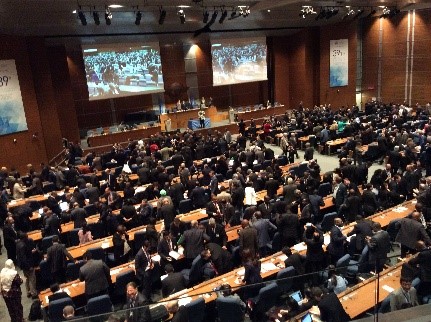
At ICAO, the implementation of specific measures is proceeding based on the 'Long-Term Aspirational Goal (LTAG) by 2050' adopted at the 41st Assembly in 2022. As a government advisor, JAL attends steering meetings and working groups of the Environmental Conservation Meeting every time, including discussions leading up to the 42nd Assembly (A42). In particular, we contribute to the formulation of international standards by making proposals that leverage our knowledge as a Japanese airline, specifically regarding the discussions on the revision of CORSIA—the framework for international aviation emissions reduction—as well as the design of eligibility criteria for SAF (Sustainable Aviation Fuel) and the CO2 credit system.
International Air Transport Association Initiatives
The International Air Transport Association (IATA) is the trade association for the world’s airlines, which support many areas of aviation activity and help formulate industry policy on critical aviation issues. At IATA, JAL plays a central role in formulating sustainability strategies for the entire industry. As a member of the Sustainability and Environment Advisory Council (SEAC), JAL makes policy recommendations through meetings held several times a year, and also continuously participates in the IATA World Sustainability Symposium (WSS) launched in 2023, leading discussions on global problem-solving. Furthermore, on a practical level, JAL participates in meetings regarding the development of the 'SAF Registry' to increase transparency in SAF supply and procurement, and the enhancement of 'CO2 Connect,' an accurate emissions calculation standard, thereby promoting the development of an industry-wide data platform.
Association of Asia Pacific Airlines Initiatives
As a member of the Association of Asia Pacific Airlines (AAPA), comprising 18 airlines in the Asia-Pacific region, JAL continuously participates in the regular meetings of the 'Environmental Working Group (EWG)' held twice a year. Taking into account the energy situation and SAF supply systems in the Asian region—which differ from those in Western countries—JAL strives to consolidate opinions and strengthen cooperation to promote decarbonization throughout the region. In particular, JAL plays a central role in leading discussions toward the stable procurement of SAF within the region and the formulation of a common environmental roadmap.
oneworld alliance Initiatives
JAL participates in the 'Environment and Sustainability Board (ESB)' meetings to strengthen collaboration among member airlines. Through the establishment of frameworks for joint SAF procurement as an alliance and the sharing of best practices for emissions reduction, we are promoting initiatives to reduce environmental impact by leveraging scale benefits that cannot be achieved by a single airline alone.
Participation in the Ministry of Land, Infrastructure, Transport and Tourism study group
JAL, together with public and private sectors, is discussing and working on technical and economic issues and solutions to achieve the 1.5℃ target of the Paris Agreement.
In order to accelerate and promote efforts to reduce CO2 emissions in overall aircraft operations more than ever, JAL actively participates in a comprehensive and combined study on the direction of Japan's efforts in the field of flight operations, with a view to strengthening the international competitiveness of Japanese aviation-related businesses from the perspective of green recovery (environmentally-conscious recovery from crisis).
JAL participates as a member of the Ministry of Land, Infrastructure, Transport and Tourism (MLIT)'s "Study Group on CO2 Reduction in the Aircraft Operation Sector" to discuss the direction of Japan's efforts in the aircraft operation sector. We also participate in the MLIT's "Study Group on CO2 Reduction in the Airport Sector," which aims to organize decarbonization measures for Japan's airports through specific studies on the conversion of airports into renewable energy hubs and reduction of CO2 emissions from airport facilities and vehicles, in order to realize a decarbonized society by 2050. In addition, as an airline, we are actively working to reduce CO2 emissions by ensuring a stable supply of SAF, lowering the price of SAF and infrastructure such as fueling facilities at airports, and participating in the creation of international rules regarding the environment, etc.
At the "Study Group on CO2 Reduction in Aircraft Operations" in FY2021, MLIT and Japanese airlines have set a common goal of replacing 10% of fuel consumption by Japanese airlines with SAF by 2030. In introducing SAF, the committee also recommended that it is important to promote the development and production of internationally competitive domestic SAF and to promote cooperation between the supply side, such as the wholesalers, and the user side such as airlines, in order to establish a supply chain in the future.
Furthermore, the "Public-Private Council for the Promotion of SAF" co-sponsored by the MLIT and the Ministry of Economy, Trade and Industry, was established as a forum for the public-private sectors to work together from FY2022, with the aim of achieving the early commercialization of SAF and internationally competitive prices.
JAL executive officers attend meetings as committee members and promote discussions, including making proposals on what should be tackled. In addition, in order to realize the development and diffusion of domestically produced SAF, the issues of SAF production and distribution were confirmed in the discussions of the Council in April 2022. Consequently, the Production and Supply Working Group and the Distribution Working Group were established, and JAL is actively participating in these initiatives. In 2023, in cooperation with Scheduled Airlines Association of Japan, an industry organization, JAL executive committee members expressed their opinions on the need to establish a system to ensure a stable supply of domestically produced SAF at internationally competitive prices from the standpoint of SAF users. As a result, government support for SAF manufacturers was secured, including CAPEX support for SAF production and supply chain development and a tax credit for domestic production in strategic sectors (tax credit based on the volume of SAF produced and sold).
Activities at the Transport Research Institute
For the purpose of research and awareness raising regarding CO2 reduction initiatives in the aviation sector, JAL participates as a committee member and speaks at civil aviation symposiums held in Washington and Tokyo.
Initiatives with Scheduled Airlines Association of Japan
The Scheduled Airlines Association, an industry organization of Japanese domestic airline companies, is promoting industry-wide efforts to reduce CO2 emissions and introduce SAFs in cooperation with member companies. JAL's Group CEO, as a key organizational member, serves as a board member and chairman of this organization every other year, and leads the industry association's policies. In November 2021, when our Group CEO was serving as chairman, it declared "2050 Carbon Neutral" as an action goal for all member companies, and actively participates in various policy discussions and councils, such as the "Public-Private Council for the Promotion of SAF", and raise issues and make policy recommendations through the Scheduled Airlines Association. In addition, it is actively working toward the realization of a sustainable society by reducing of plastic and food waste, effectively using resources such as paperless operations, and not only by maintaining and strengthening our airline network, but also by making local contributions through promotional activities for regional and local products and cooperation in nature conservation, and DEI.
Addressing misalignment
Where industry associations have unclear or misalignment positions and advocate for policy change that runs counter to JAL Group’s interests or position, to agree on a way forward, JAL Group's preference is to engage the industry association to:
1. Make clear how their position is misaligned with ours.
2. Assess why the position is misaligned.
3. Determine if and how their position(s) can change, and over what time periods.
4. Provide and agree on specific recommendations for how the industry association can address misalignment.
5. Review progress on agreed actions.
CO2 Reduction Initiatives
Aircraft and technology manufacturers, collaboration with universities
Through ICAO and IATA, we are working with manufacturers to continually upgrade to fuel-efficient aircrafts, reduce the weight of aircraft and loads, improve flight efficiency, and improve fuel efficiency through maintenance work. In order to improve fuel efficiency and reduce the impact on the environment, we hold hearings with aircraft manufacturers about zero-emission new aircraft types, such as hydrogen planes and electric planes, and are working with collaboration to resolve technical issues.
JAL Group employees are also dispatched to universities to participate in research on new technologies such as hydrogen aircrafts.
Participation in Industry-Government-Academia Collaboration on Future Air Control Initiatives
The Civil Aviation Bureau of the Ministry of Land, Infrastructure, Transport and Tourism (MLIT) has launched the "Collaborative Actions for Renovation of Air Traffic System (CARATS)" to make the future air traffic system safer and more efficient and to address common global issues such as climate change. JAL actively participates in CARATS by providing flight data to researchers, cooperating in flight simulator verification, and exchanging opinions with the Civil Aviation Bureau and researchers. As part of these efforts, we have realized the introduction of a satellite-based approach method that includes highly accurate curved routes (RNP-AR method), and are working to reduce CO2 emissions by shortening flight distances at many airports.
In 2020, JAL, as a member of a joint public-private project, contributed to the realization of the elimination of speed limits in the control area from the perspective of reducing environmental impact. If the speed limit is reduced at altitudes within the control area (up to 3000 ft) during takeoff climb, the aircraft will be able to retract flaps and accelerate from a lower altitude immediately after takeoff, which will have the advantage of reducing CO2 emissions, fuel costs, and improving on-time performance. As a result of surveys of conditions in other countries and verification of the effectiveness, the speed limit was eliminated in 2021, allowing JAL to operate under a method (NADP2) that both shortens flight time and reduces fuel consumption. This is equivalent to the amount of CO2 absorbed by 33,071 cedar trees in one year.

Route Planning Technology Improvements
CO2 emissions can be reduced by curtailing the flight distance in the flight paths. JAL Group is collaborating with air transport control authorities in and out of Japan to fly user preferred routes (UPR), a unique flight path for each aircraft under certain restrictions such as weather conditions.
See Reducing CO2 Emissions in Daily Operations
SAF Initiatives for Dissemination Expansion
The JAL Group aims to achieve net zero CO2 emissions by 2050 by replacing 10% of fuel load with SAF by 2030 and reducing total CO2 emissions below 90% level of the actual amount of fiscal year 2019 levels. In regions outside of Japan, we have invested to Fulcrum BioEnergy Inc., a US venture company that manufactures SAF.
In Japan, with technical support from Green Earth Institute Co., Ltd., we used a bioprocess using microorganisms developed by the Research Institute of Innovative Technology for the Earth, and spent approximately one year and three months at facilities in Japan to complete the first domestic SAF. On February 4, 2021, Japan's first domestically produced SAF made from cotton clothing exclusively using domestic technology was loaded for the first time on a domestic scheduled flight. In addition, as part of the “Development of Production Technologies for Biojet Fuels” of New Energy and Industrial Technology Development Organization (NEDO), a Japanese national research and development agency, JAL has conducted a flight with 3,132 liters (9.1% mixing ratio) of SAF produced domestically in Japan added in existing fuel, manufactured by Mitsubishi Power, Ltd., Toyo Engineering Corporation, JERA Co., Inc., and by IHI Corporation. The former is created from wood chips and the latter from algae. It was the world’s first attempt to load 2 different types of SAF on the same flight.
In addition, in order to spread SAF load within Japan, we will connect various stakeholders and build a manufacturing and supply system, as well as contributing to be able to use SAF with sustainable price range. As an initiative, we are conducting a feasibility study with Japanese companies on manufacturing and selling SAF in Japan from waste plastic. For more on the development of SAF and dissemination, see Development and Use of Sustainable Aviation Fuel (SAF).
World Economic Forum (WEF)・Clean Skies for Tomorrow (CST)・Green Fuel Forward (GFF)
As a member of World Economic Forum's Clean Skies for Tomorrow, an independent, non-profit organization that promotes exchanges among leaders in political, economic, and academic fields to address global and regional economic issues, JAL is participating in a project to measure the environmental impact of the aviation industry.
According to a Clean Skies for Tomorrow research paper, the aviation industry accounts for 2-3% of global CO2 emissions, and there is an urgent need for efforts to reduce CO2 emissions, including fuel-efficient aircraft and SAF. JAL signed the Clean Skies for Tomorrow Ambition Statement in September 2021, declaring 10% replacement of total fuels to SAF.
Furthermore, starting from October 2025, JAL will participate in 'Green Fuel Forward (hereinafter "GFF")' an initiative aimed at expanding the demand for SAF in the Asia-Pacific region, launched by the World Economic Forum and GenZero—a decarbonization-focused investment platform in Singapore. We will actively contribute to the creation of schemes to expand SAF demand within the region.
Engaging in Emissions Trading - JAL Carbon Offsetting -
In response from feedback from customers who have a keen interest in protecting the environment and preventing global warming, the JAL Group, in collaboration with CHOOOSE, offers passengers the option to offset the CO2 emitted by the aircraft they fly on through our JAL Carbon Offset program. See JAL Carbon Offsetting.
Others
Cooperation in Climate Change Studies
From 1993, the JAL Group has been observing the atmosphere with the Meteorological Research Institute and JAL Foundation. From 2005 the CONTRAIL Project continues today with the National Institute for Environmental Studies and JAMCO Corporation.
Greenhouse gases data, which was observed from scheduled international flights and officially announced through the national Institute for Environmental Studies, is being used in a number of global research studies. In 2018, 1,424 observations were made from JAL flights and the reported data was used in three peer-reviewed thesis, and as reference materials in nine international academic conferences and six domestic academic conferences.
In March 2019, the CONTRAIL Project was awarded the Minister of Environment Award of the First Japan Open Innovation Prize (JOIP).
Collaborative Research with External Parties
JAL and Mitsubishi Heavy Industries have signed an agreement to use "Lilac" , a lightning strike avoidance decision support service that enables highly accurate prediction of lightning strikes on aircraft in 2024. The collaborative research between JAL and Mitsubishi Heavy Industries has enabled the development of an AI prediction model that can accurately predict the location of likely lightning strikes during flight. The jointly patented technology will also be used to provide information on thunderclouds from the ground to pilots in flight, enabling them to select arrival routes and adjust landing times to avoid lightning strikes. This service also serves as a climate change adaptation measure by mitigating the effects of lightning strikes, which are predicted to increase in frequency along with the extreme weather events associated with climate change. JAL considers the decrease in passenger volume and increase in flight cancellations due to climate disasters caused by extreme weather events and changes in precipitation and climate patterns to be a risk. Although climate change is expected to cause an increase in lightning in the future, the introduction of "Lilac" is expected to prevent schedule delays and flight cancellations. JAL will accelerate its response to climate change based on this collaborative research with other companies.
Use of Plant-based Meat
In recent years, an increasing number of people, especially in Western countries, are choosing plant-based meat and fish products. We surmise that this is due to five global social issues: greenhouse gas emissions, health, animal welfare, biodiversity, and food diversity. JAL offers vegan and vegetarian meals as well as inflight meals and lounge meals used plant-based ingredients. JAL continues to provide vegan and vegetarian meals as well as plant-based menu items on board and in lounges. We will continue to monitor the latest trends, social conditions, market information and customer feedback to adopt new ingredients.


Development of Sustainable Inflight Meals
According to the Food and Agriculture Organization of the United Nations (FAO), only 12 types of crops and 5 types of animal products account for 75% of the global food supply. This imbalance is said to cause problems such as climate change, vulnerability to pests, and loss of biodiversity, as well as health effects due to nutritional imbalance.
In cooperation with Unilever, JAL has developed a sustainable inflight meal/lounge meal based on the “Future 50 Foods” listOpen link in a new window, which is composed entirely of plant-based foods. The “Future 50 Foods” is a list of foodstuffs released by Unilever in collaboration with the UK World Wildlife Fund (WWF), aiming to solve the world's food problems such as starvation, which is a concern due to expected population growth *, from the viewpoints of greenhouse gas emissions at the production stage, environmental impact, resistance to climate change and pests, nutritional value, soil resilience by production, and farmland area control. Using ingredients from this list not only supports a nutritious, healthy and balanced diet, but also contributes to reducing greenhouse gas emissions, protecting water and soil, and promoting biodiversity.
In developing inflight meals, we will continue to take on the challenge of creating sustainable inflight meals for the future, not only by paying attention to the taste but also by solving a variety of social issues.
* According to the United Nations' 2019 Data Booklet, the world's population is expected to reach 9.7 billion in 2050.
JAL expresses support for Food Systems Summit 2021("FSS2021") which is held to promote concrete actions for the transformation to sustainable food systems. The JAL Group’s commitment is stated in the UN FSS2021 websiteOpen link in a new window.
Service Delivery Collaboration
Drones and flying vehicles are a cleaner means of transportation, emitting less CO2 than vehicles powered by internal combustion engines.
As a professional aviation company, JAL aims to create a prosperous and sustainable society through comprehensive air mobility operations that are safe and secure. The JAL Group is conducting trials of drones and various other activities with the aim to commercialize drones by fiscal 2023.
In February 2022, as part of the "Drone Logistics Platform Social Implementation Project in Tokyo" adopted by the Tokyo Metropolitan Government, we conducted the first demonstration experiment in Tokyo of pharmaceutical delivery using drones to cross multiple bridges, including the Eitai Bridge over the Sumida River. The project aims to realize a society in which medical supplies can be delivered immediately on-demand in the event of an emergency or disaster, or on a daily basis, regardless of road congestion. Utilizing JAL's airline network and expertise in air transport operations and safety, the project aims to improve access to medical care and shopping and to solve labor shortage issues in the logistics industry by using drones to transport the last one mile to remote islands and mountainous areas, in addition to transporting large volumes of cargo between airports by air. We aim to solve the problems of labor shortages in the logistics industry. We are making continuous preparations to solve logistics problems in outlying islands and mountainous areas where access to medical care and shopping is difficult, and to transport emergency relief supplies in the event of a disaster.
The JAL Group aims to commercialize "AIRTAXI" services in fiscal 2025 using electric Vertical Take-off and Landing (eVTOL) aircraft, which are environmentally friendly and highly mobile. We believe eVTOL have the potential for use in not only transportation and sightseeing from the airport, but also medical emergency response operations and disaster relief operations.
See the Air mobility website for details.